You Didn't Design This Building
Employee Success Is the Next Customer Success
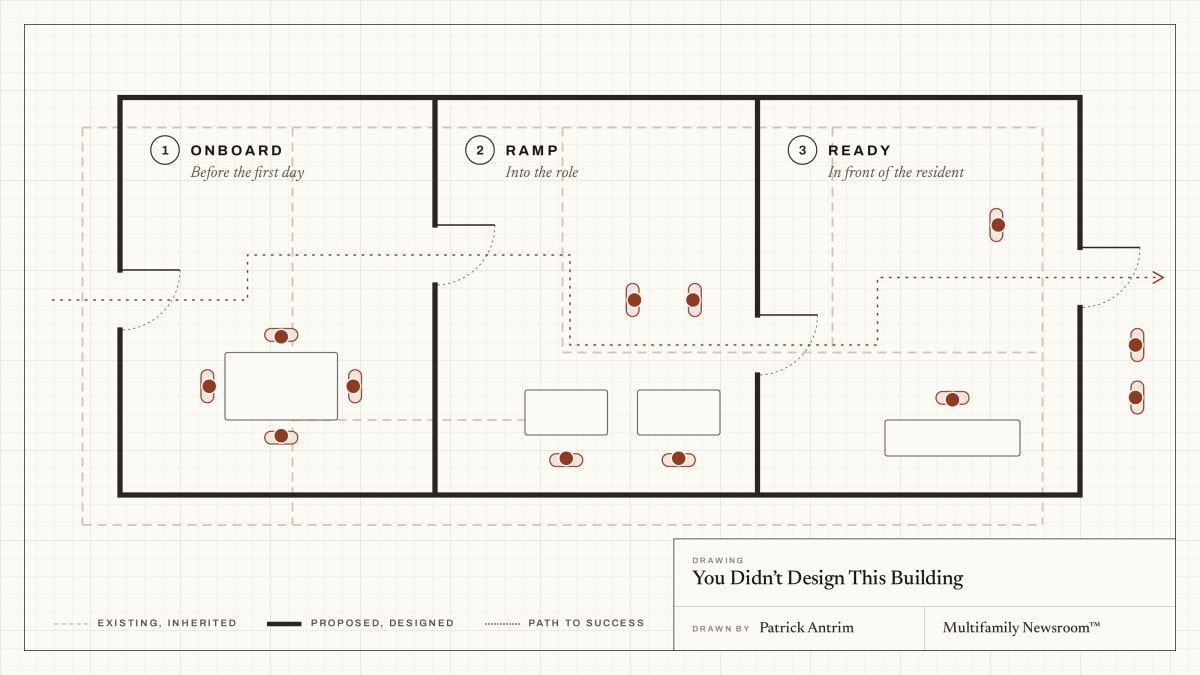
SCOTTSDALE, ARIZONA, NOVEMBER 5, 2026 — Look around the building you're in as you read this. There's a good chance you didn't design it. Someone else decided where the walls went, how the light comes in, where people gather and where they don't. You inherited it, and you've been making it work ever since.
Most organizations in multifamily are the same.
Our industry grows by acquisition. We buy portfolios. We win new management accounts. We merge with other operators. Every one of those moves hands a leader a team, a set of processes and a culture that someone else built for a different moment. So for most of us, the job has been to optimize what we were given.
That job is changing. And the way it's changing looks a lot like something that happened in software two decades ago.
From customer support to customer success
For a long time, software companies treated customer support as an expense. It was the help desk. Tickets came in, problems got fixed, and a good department was one that responded fast and ran cheap.
Then some smart people asked a different question. What if getting the customer wasn't the finish line? What if the job was making sure the customer actually succeeded?
In 1996, Marie Alexander built a department called Customer Success at the CRM company Vantive, according to the Customer Success Association. It started with one question for every customer: how will you define your success? Then in 2005, Salesforce found it was losing 8% of its customers every month, a story Nick Mehta, Dan Steinman and Lincoln Murphy tell in their book Customer Success (Wiley, 2016). The answer wasn't a faster help desk. It was making sure customers were onboarded, adopted the product and got real value from it.
Here's what those companies learned. When customers succeed, they stay longer. They buy more. They tell other customers. They become ambassadors and do your marketing for you. A department that had been a cost became a growth engine, and customer success became a revenue line.
I believe multifamily is at that same moment with its people.
Everyone has the same tools now
AI and technology are rearranging work in every department of the apartment business: leasing, maintenance, resident communication, accounting and reporting. The tools are good, and they're getting better fast.
But everyone can buy them. If your competitor can buy the same leasing assistant, the same platform and the same AI agents, the tool isn't your advantage. It's the cost of entry.
What's left is how well your people succeed with it.
That's employee success. It isn't talent acquisition, and it isn't a hiring problem to solve. Customer success said it wasn't enough to get the customer. Employee success says it isn't enough to fill the seat. Once someone is inside your organization, the work is making sure they win: onboarded, ramped into the role, and ready to stand in front of a resident and make smart decisions for the business.
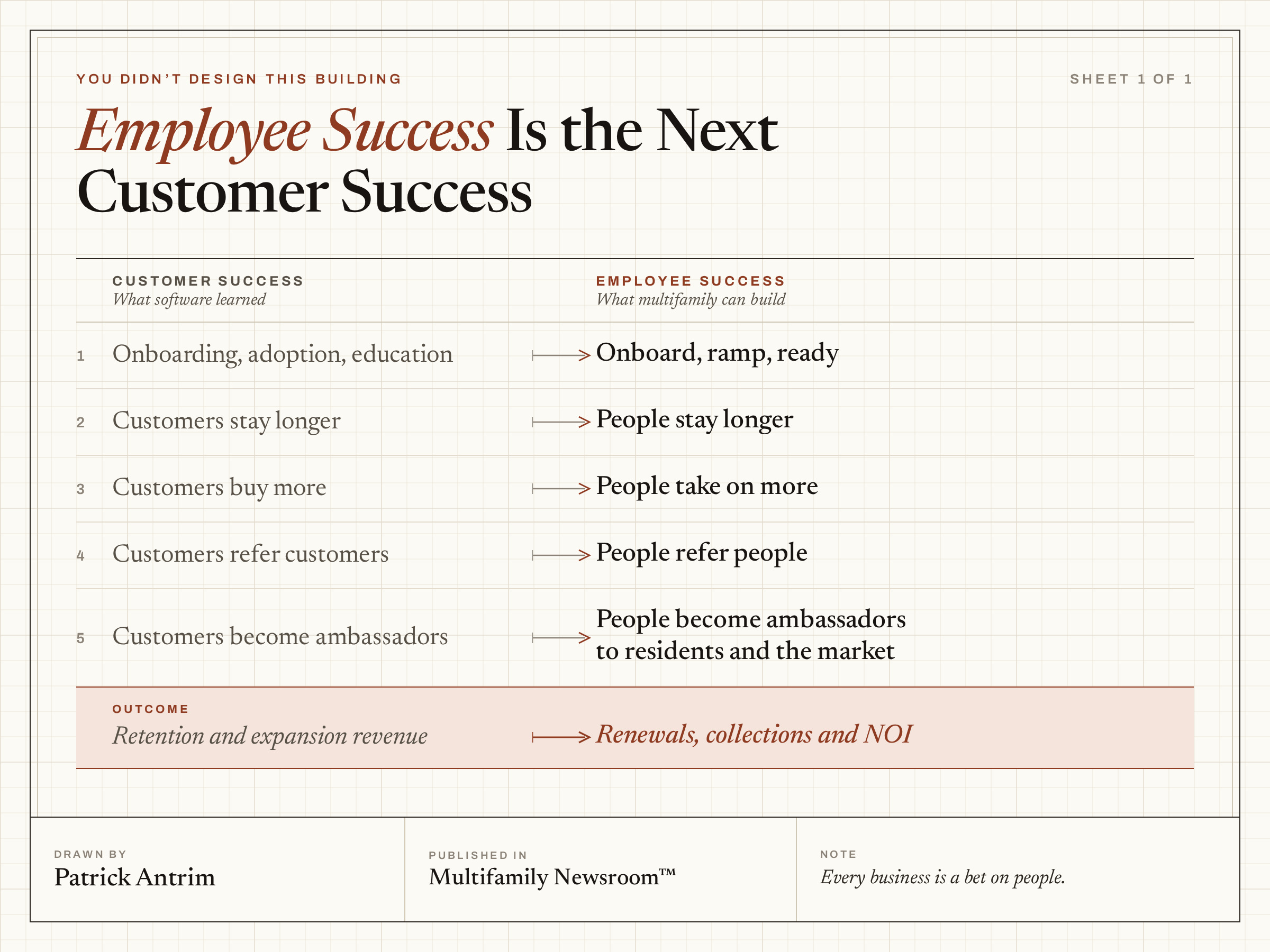
When people win, they show up with new capabilities. They drive the yield. They move faster. They protect collections and NOI. Most leaders don't think about employee success as revenue. They're focused on rents, collections, restructuring and exits. But every one of those outcomes comes from the people doing the work.
The opportunity is design
Here's why this moment is different. For years, optimizing an inherited organization was the only practical choice. The work didn't change much, so you tuned the team you had.
Now the work itself is changing. That gives leaders something most of their predecessors never had: a real chance to design the organization instead of just inheriting it.
So ask yourself one question. If you were building this company today, knowing everything that's now possible, what would you design?
That's where the leverage is. And the answer starts with a different set of skills.
The skills are different now
For a long time, value in our business sat with the people who held the knowledge. The regional who knew every lease clause. The accountant who knew where every number lived. The community manager who had seen every situation twice.
AI holds a lot of that knowledge now. People don't need to carry it in their heads. They need to execute with it. That changes what leaders have to be good at.
Creating psychological safety. The brain reads anything unfamiliar as a threat, and people who feel threatened protect themselves. They don't change. Your team only shows you the real problem when it feels safe to. Alex Resnick, CEO of Evolve Leadership, who teaches change communications in our CCML program, puts it simply: be hard on the problem and soft on the person.
Moving people productively through change. On October 28, Gallup reported that U.S. employee engagement fell to 29% in the third quarter of 2026, its lowest level since 2011. Only 46% of employees strongly agree they know what's expected of them at work, and 37% strongly agree someone at work cares about them as a person. The sharpest declines came among remote and hybrid employees in organizations adopting AI. Gallup's earlier analysis found that when frequent AI use, a clear plan and manager support were all present, engagement reached 53%. The tool alone doesn't get you there. The manager does.
Leading an aging workforce with empathy. In 2025, the median age of property, real estate and community association managers was 49.6, compared with 42.1 for all workers, according to the Bureau of Labor Statistics. About 38% were 55 or older, versus 23% of the workforce overall. These are often our most experienced people. They built the relationships, the judgment and the resident trust this business runs on, and many of them are now being handed tools that work nothing like the ones they mastered. If that change feels like a threat, they'll protect themselves. If it feels like support, they'll bring decades of judgment to the new tools. Empathetic leadership is how every employee succeeds, not just the ones who adapt first.
Treat it like revenue
Customer success worked because companies stopped treating it as a cost to cut and started treating it as a growth engine to invest in. They owned the outcome. They measured it. They tied it to revenue.
Employee success asks the same of us. Own whether your people succeed, not just whether the seat is filled. Measure it. Connect it to the numbers you already watch: renewals, collections, turn times and NOI.
For 12 years, we have been inside companies with some of the healthiest workforces in the industry through Best Places to Work Multifamily®, our national workforce engagement research. The pattern is consistent: the companies pulling ahead are not lucky with talent. They select differently and prepare differently, before the first day, not after the first stumble. This year's research will be revealed on the main stage at the Multifamily Innovation® Technology & AI Summit, December 1-3.
You may not have designed the building you're sitting in. You don't have to keep running an organization someone else designed, either. The tools will keep changing, and everyone will have them. The companies that win will be the ones whose people succeed with them.
One question to take back to your team this week: if you designed your organization from scratch today, who would be ready to succeed in it, and what would they need from you?
Every business is a bet on people.